
The Best Backcountry Touring Boots Of 2027
Powder aims to feature only the best products and services. If you buy something via one of our links, we may earn a commission.
Sure, for us diehards, the recent rise in popularity of backcountry skiing might feel like it’s coming at a cost. Trailheads are getting busier and our secret stashes aren’t so secret anymore, but one upside is the fact that backcountry gear has gotten really really good, and nowhere is it more apparent than when looking at backcountry touring boots. Just a few years ago, our options were extremely limited, and we really had to choose between light and stiff. These days, with brands dumping huge budgets into R&D on the boot front, a huge crop of really capable boots exists that not only balance uphill and downhill performance, but offer sizing and fit options that should suit the needs of any backcountry skier.
Before we take a look at five of the best backcountry boots of 2027, here are a few things to consider before pulling the trigger on a new pair of boots. Like with any ski gear purchase, realistic use case is the first thing to consider. What type of skiing are you actually planning to use these boots for?

James Temple
Types of Touring Boots
Skimo/Race: These are the lightest of ski touring boots, and are specifically designed to maximize uphill efficiency for skimo racing by stripping the boot down to its bare essentials. Don’t expect to actually go skiing in these, but you’ll absolutely fly uphill on the skintrack and bootpack. These typically tip the scales at around 500-700 grams a foot. Unless you’re racing the clock, don’t bother.
Light Touring/Ski Mountaineering: The lightest option for a truly “skiable” boot, this category blends design elements from skimo racing boots with slightly heavier, stiffer, and more comfortable construction. Typically made with just two buckles, these strike a balance between uphill performance and just enough support and damping to actually ski downhill. These tend to weight right around the 1000g/foot mark. Great for big backcountry missions and driving smaller, lighter touring skis.
Freeride Touring: These are the burliest dedicated backcountry boots, designed to offer no-compromise downhill performance while still offering generous walk modes and competitive weights. Many are traditional four-buckle designs, with stiff flexes for aggressively driving big skis in variable conditions.
Hybrid/Crossover: Essentially alpine boots with a walk mode and tech fittings, hybrid boots are meant mostly for resort skiing, with occasional tours or bootpacks in mind. These offer the best ski performance at the cost of uphill efficiency. Some even skip the walk mode entirely. Mostly ski the resort, but want to tour out the gates every once in awhile? These are for you.

Lily Ritter
Touring Boot Terminology
Range of Motion: One of the most-discussed points on a touring boot, the boot’s range of motion is determined by how far it can flex forwards and backwards in walk mode. While many boots advertise huge ROMs, the effective range is actually determined by the liner and how much friction is caused by the ankle pivots during a stride. Big ROMs generally mean more efficient uphill travel, but can come at the cost of downhill stiffness.
Walk Modes: The whole point on a backcountry touring boot is to be able to transition the system to be able to stride uphill. That’s accomplished by designing the boot around a walk mode. While these come in many shapes and sizes, the basic principle is the same: unlock the rigid connection between the shells lower and upper cuff. Some boots use external hardware, some use complicated internal systems, while others integrate it all into the buckles that close the boot.
Shell Design: Like alpine boots, touring boots fall into either the cuff/overlap design camp or into the three-piece (tongue-style) design philosophy. Both are viable options, but, like their alpine counterparts, grant the skier different fits and features and a somewhat different experience on snow.
Shell Materials: Most touring boots utilize lighter weight plastics and carbon fiber in their construction to save weight. Common types are Grilamid and Pebax, though many boots are now offered with PU plastic construction, the same that’s found in heavier and more damp alpine boots. Grilamid is light and very stiff, though it lacks elasticity and damping properties, often making boots feel overly rigid. Pebax is a happy medium, and PU is heavy, but offers superior damping, the smoothest flex, and the best ski feel.
Sole Types: Something to watch out for with touring boots is the sole type. Not only will this determine which kind of bindings the boot is compatible with, but also your experience when bootpacking. Most boots on the lighter end of the spectrum feature a rockered “AT” sole that conforms to the ISO 9523 standard. These tend to feature rubberized soles and are great to walk in or scramble around on rocks with, though care must be taken to ensure the sole doesn’t wear down past the point of function. Heavier, hybrid boots tend to come with GripWalk-compatible soles and often feature replaceable sole blocks. Unlike ISO 9523 boots, these can be used with alpine bindings.
About Powder’s Editor’s Picks
Our Editor’s Picks lists are collections of the skis, boots, outerwear, and other gear that stood out to us while testing. If you want to learn more about how reviews work at Powder, we’re very transparent about our process.
These lists are constantly growing and evolving as we try new gear, all season long. If you’ve got a favorite piece of equipment that you think we should write about, let us know here. And, if you represent a brand or company and think your gear deserves a writeup, we’d love to get in touch.
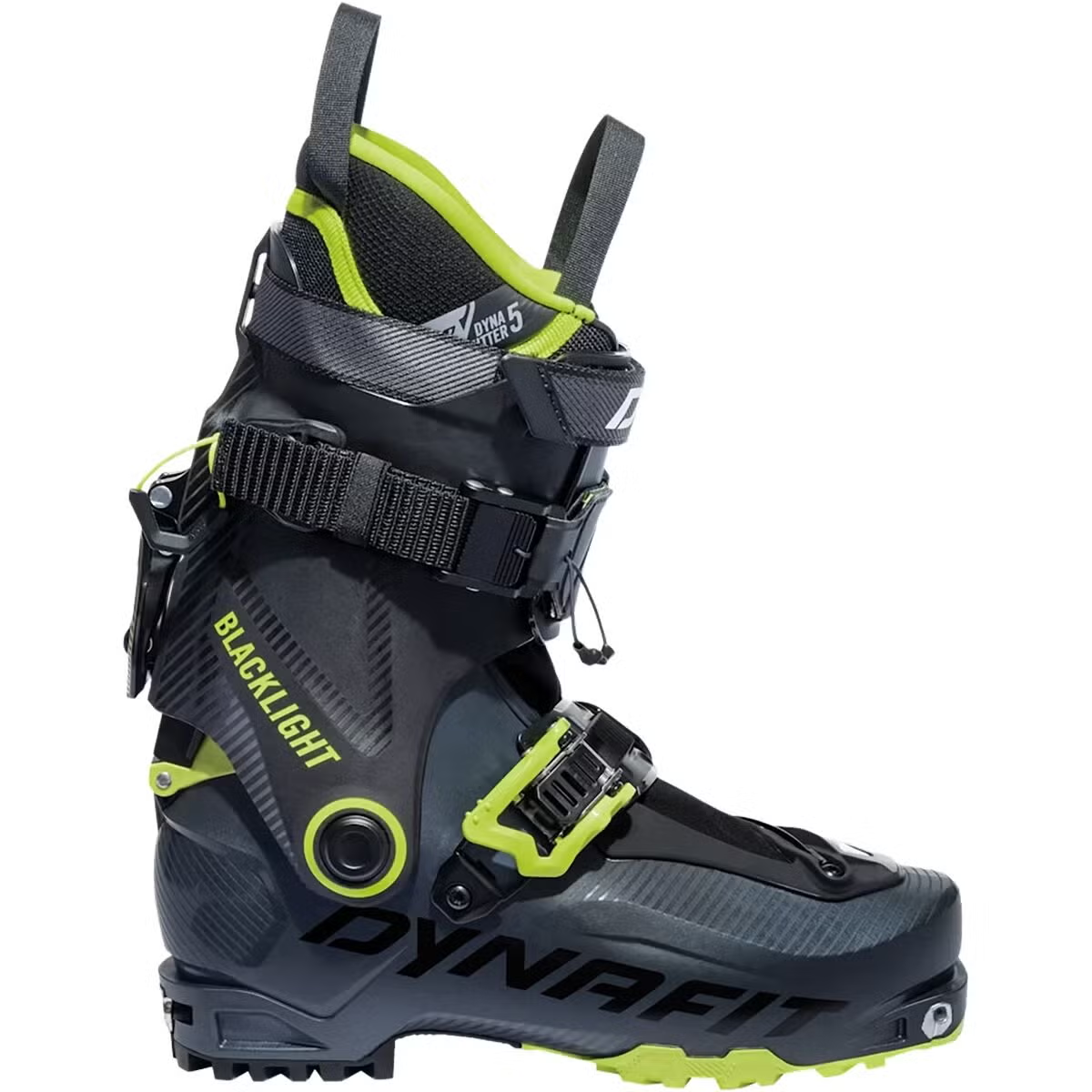
Dynafit Blacklight 2.0
- Sizes available: 25-30.5 (men’s) | 23-27.5 (women’s)
- Stated Weight: 1140g
- Stated Flex: not stated (it’s stiff)
- Binding Compatibility: tech only
- Closure: 1 forefoot buckle, upper Hoji Lock, power strap
- Shell Material: Grilamid + carbon
- Forward Lean: 12° – 15° + Release for Walking
- Walk mode ROM: 70 degrees
- Stated last width: 101mm
- Best for: technical ski mountaineering, wide feet
Dynafit’s newest two-buckle boot is a story of contradictions, not compromises. It’s both wildly stiff and extremely light, and walks better than some hiking boots I’ve worn. The magic lies in the smart integration of the Hoji Lock walk mode system that uses a slop-free internal connection between the upper and lower.
Deciphering Dynafit’s Euro marketing-speak actually points to the ideal skier for these boots. A boot designed for “ambitious speed tours” is a boot meant for folks that care just as much about the down as they do about the up. The new Blacklight 2.0 is going to make high-level recreational backcountry skiers, ski mountaineers, and mountain guides very happy. If your skis days consist of lots of walking (5k+ foot vert days) to get to technical terrain, pow skiing, and might include a fair amount of scrambling or technical climbing, this is going to be an excellent choice. Its wider forefoot (but narrow heel pocket) should accommodate a variety of foot shapes, and the slimmed down Hoji Lock walk mode, huge range of motion, and stiff flex make it a perfect companion for skiers looking to push deeper in the mountains under their own power.
Simply put, the Blacklight 2.0 is the stiffest two-buckle touring boot I’ve ever skied. The flex pattern on the Blacklight doesn’t have the damp, long-travel feeling of a bigger, heavier boot. Instead, it’s like riding a short-travel mountain bike that’s got extremely capable geometry. The Blacklight’s fore/aft flex supports you, but it doesn’t quite take the edge off like a bigger, heavier boot. Laterally, however, the locked-in feeling of the Hoji Lock system provides instantaneous response when initiating a turn and powering through.
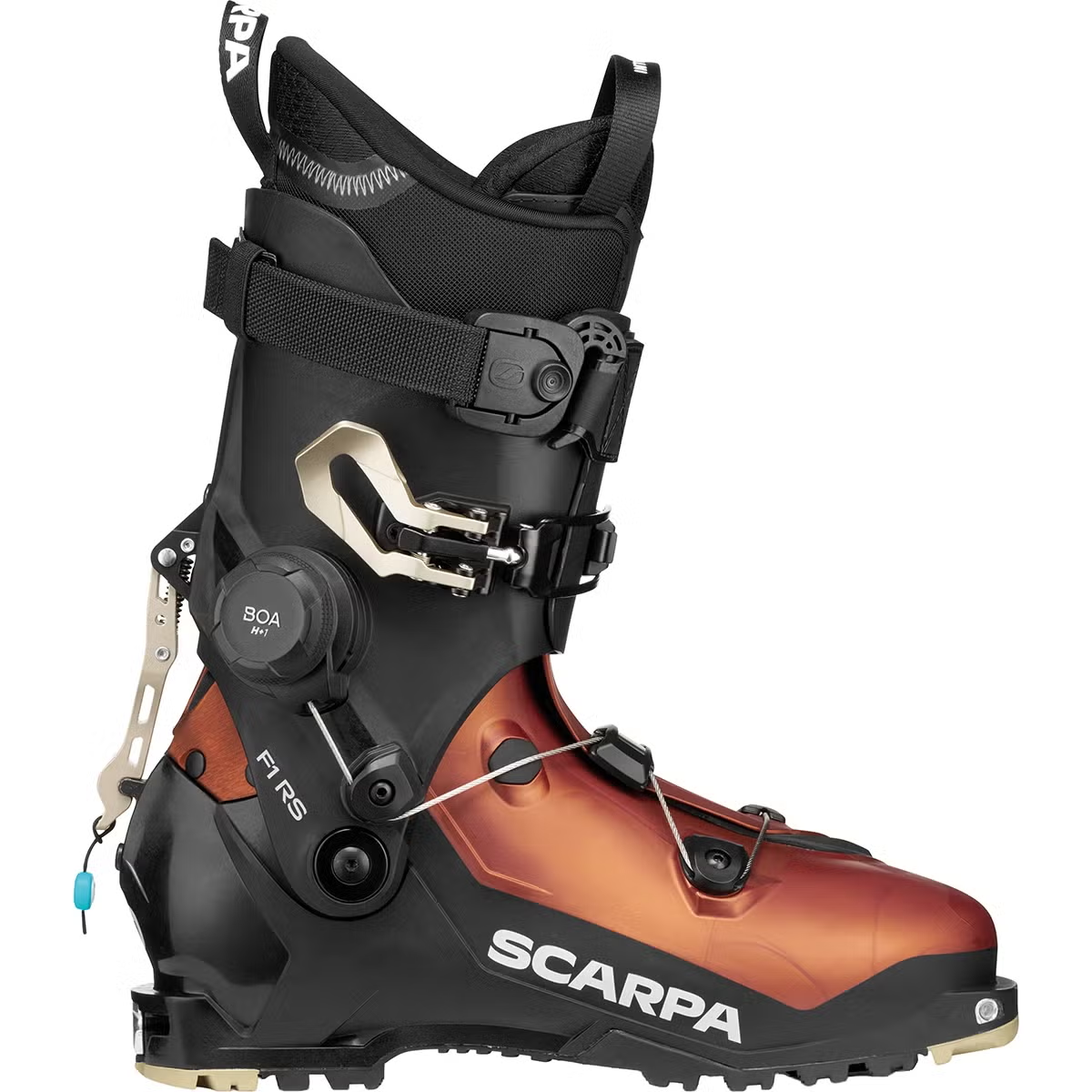
Scarpa F1 RS
- Sizes available: 24.5-31.0
- Stated Flex: 115
- Binding Compatibility: Tech, AT
- Closure: BOA dial, upper buckle, power strap
- Shell Material: Grilamid, fiberglass, Pebax
- Range of Motion: 60 degrees
- Forward Lean: 15, ± 2 degrees
- Stated Last Width: 101mm
- Stated weight: 1340g
- Best for: huge days on big skis
Scarpa’s wide-ranging line of F1 touring boots have been much loved among the backcountry crowd for balancing weight, walkability, and good ski performance in a comfortable package. The new F1 RS continues that legacy with some clever design updates, including the addition of a BOA H+i1 dial in lieu of forefoot buckles.
For anyone who’s struggled to get along with the low volume fit of Scarpa touring boots in the past, it’s worth giving these a shot. A 101mm last, soft plastic around the instep, and a stock Intuition liner make these fit extremely well. The boot’s cuff height feels quite tall, something I think some skiers might take issue with, especially those with sensitive calf muscles–but it does help give the boot a nice progressive flex.
That progressive flex is exactly what sets this boot apart. It’s not overly stiff, but it’s oh-so-smooth. These are an absolute dream to walk uphill in. I’ve found that boots with too much going on inside (in terms of overlapping plastic layers, liners, etc.) tend to create hot spots, pressure points, and other undesirable sensations over the course of a long day with many transitions. The very simple overlap design of these eliminates much of that.
Point them downhill, and the boots feel very energetic, which turned out to be really fun once I adjusted my skiing a little bit. They’re stiff, but not in the on-off way of a Grilamid-only boot. I found that driving bigger skis, especially in weird snow, actually took a lot less effort than I expected. The progressive nature of the flex (meaning it gets stiffer the more you push into it) really allows you to relax a little bit and let the boot/ski combo do much of the work of shock absorption.
Dynafit Radical Pro
- Sizes available: 22.5-27.5 (W), 25.0-31.5 (M)
- Stated Flex: 120 | 110 W
- Binding Compatibility: Tech, ISO 9523
- Closure: 2 forefoot buckles, upper Hoji Lock, power strap
- Shell Material: Grilamid + glass fibers
- Forward Lean: 11 degrees
- Range of Motion: 60 degrees
- Stated Last Width: 104mm
- Stated Weight: 1400g
- Best for: one-boot backcountry quiver
The newly-updated 2027 Dynafit Radical Pro is a no-compromises backcountry boot. It doesn’t promise resort skiing power, or skimo-level weight, but it’s ready to take you up and down whatever mountain you please, transition quickly and smoothly, and provide a solid, predictable ride on the way back down. It’s clever design makes backcountry skiing really easy, and in the age of boots and bindings that require an engineering degree to set up and use properly, this is a refreshing break from that. Simply put, you can slide your foot into this and go have a really good time in the backcountry.
Dynafit slightly adjusted the fit from the old version, and the flex feels both stiffer and a bit smoother. There’s no carbon in the boot, but glass fiber-reinforced Grilamid in the cuff is paired with pure Grilamid in the lower. It’s not the lightest boot by any means, but if there’s something we’ve learned over the years, it’s that heavier boots nearly always ski better.
Dynafit’s Radical Pro is a one-stop shop for any and all backcountry skiers. Whether you’re out there making hop turns down steep ski mountaineering lines, seeking untouched powder lap after lap in your secret zone, ski guiding, or just getting out a few days a year and want a comfy boot, look no further. The ski performance is there, the uphill performance is there, and the fit should cover most bases.

Tecnica Decoy Pro
- Sizes available: 22.5-30.5
- Stated Flex: 130
- Binding Compatibility: Grip Walk, tech
- Closure: 4 buckles, elastic power strap
- Shell Material: PU lower, Grilamid cuff
- Forward Lean: 15.5 degrees
- Ramp Angle: 3.75 degrees
- Range of Motion: 65 degrees
- Stated last width: 99mm
- Stated Weight: 1650g
- Best for: backcountry freeride skiing
Perhaps the most anticipated backcountry boot of the year, Tecnica’s new Decoy Pro was designed to be an aggressive, no-compromise backcountry freeride boot. More than just an evolution of the fan-favorite Zero G Tour Pro, these are a ground-up rethinking of how to build a stiff, powerful backcountry boot.
While outwardly, they look quite similar to the Zero G Tour Pro, the magic lies in the switch to using PU plastic in the shell. Sure, that makes it heavier, but the trade-off is well worth it for how smooth and damp the boot feels when skiing, particularly in crap snow.
Once you’re locked into downhill mode, these things have remarkable stability, truly impressive damping, and enough stiffness and responsiveness to drive legit skis. That very smooth flex and quiet character really shines in variable and heavy snow conditions (think spring pow that’s gotten a little too much sun, refrozen couloir aprons, or wintertime dust on crust) where it prevents the boot from deflecting and getting bounced around–much like an alpine boot.
Yes, it can be skied inbounds, but don’t buy it for that. Instead, buy it if you want to ski in the backcountry the way you can (or like to think you can) inbounds.
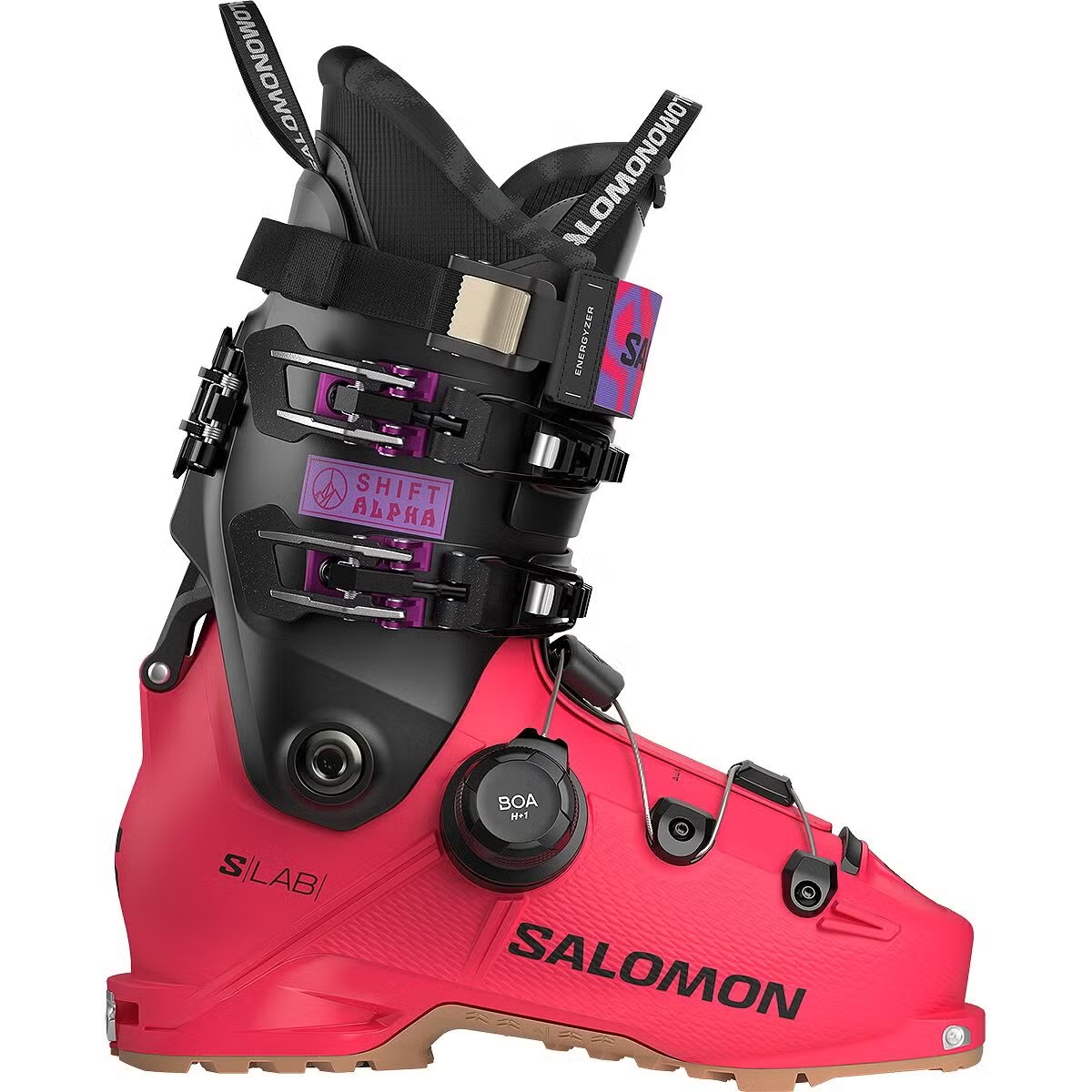
Salomon Shift Alpha Pro
- Sizes available: 22.5-30.5
- Stated Flex: 140
- Binding Compatibility: Alpine ISO 5355, Grip Walk, Tech
- Closure: BOA, 2 buckles
- Shell Material: PU lower, Pebax cuff
- Forward Lean: 13.5 degrees
- Ramp Angle: 4 degrees
- Range of Motion: 65 degrees
- Stated Last Width: 98mm
- Stated Weight: 1840g per boot (27.5)
- Best for: sidecountry tours, sled skiing
I’m always a fan when a brand takes a product that’s already pretty good and does subtle tweaks to make it even better–without messing with the basic things that made the product great from the start. Salomon did just that with the new Shift Alpha BOA. At first glance, the new boot looks identical to the older version (save for the color update…I did like the purple). That’s because the cuff and lower are, in fact, identical. The cuff is still made of lighter-weight Pebax, while the lower features heavier and damper PU plastic. The notable change is an extra piece of plastic between the cuff and lower, wrapping the instep underneath the ExoBelt BOA fastener, and adding extra stiffness.
That added stiffness makes this the most powerful boot of the bunch, and I’d be happy to ski these in the resort. The walk mode is there, but doesn’t offer great range of motion. Instead, the point of this boot is to ski aggressively.
Salomon’s Shift Alpha BOA is clearly aimed at a pretty niche bit of the ski market, but does what it sets out to do very well. I wouldn’t recommend this as a pure backcountry boot, unless you really don’t care about the limited walk mode ROM, but it’s an awesome choice as sidecountry or sled-skiing boot, and would make a great work boot for mechanized guides, patrollers, or prodution folks.

Leave a Reply